# Understanding Reasoning LLMs in 2026
*How today's open models learn to think, from DeepSeek-R1 to DeepSeek V4.1, Kimi K3 and GLM-5.3*
Most large language models (LLMs) are built in two big steps. First, the model is pre-trained on a huge amount of text, where it learns to predict the next word, or more precisely, the next token (a token is a word or a piece of a word). The result is a base model, which can continue any piece of text but is not yet good at answering questions. Second, the base model is post-trained, which turns it into an assistant that follows instructions, answers questions and, more and more often, uses tools.
Reasoning models are a result of post-training. A reasoning model writes out intermediate steps before it gives its final answer, and it has been trained to make those steps useful. When DeepSeek released DeepSeek-R1 in January 2025, a reasoning model was still a separate kind of model. You used a regular model for most things and switched to a reasoning model for math, puzzles and hard programming problems, knowing that it would be slower and more expensive.
Twenty-one months later, that distinction has mostly disappeared. Two of the three big families of open models, Kimi (from Moonshot AI) and GLM (from Zhipu AI), now have flagship models whose reasoning cannot be turned off at all. The third family, DeepSeek, gives its newest model a reasoning effort setting that goes from 1 to 100. Figure 1 shows how each family got there.
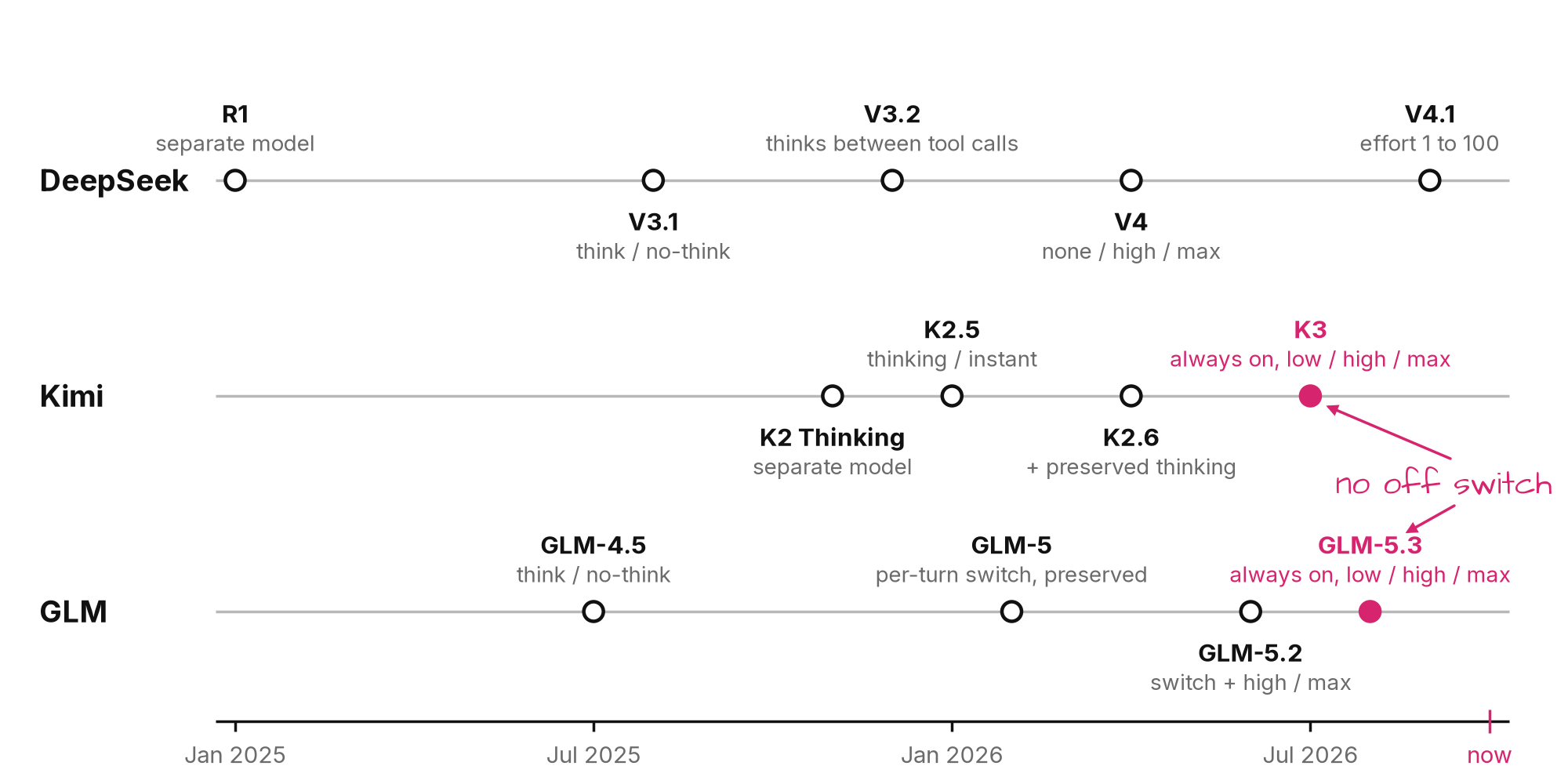
*Figure 1: How the reasoning controls of three open model families changed since DeepSeek-R1. The months come from the technical reports, or from the Hugging Face repository where a model has no report.*
As we can see in Figure 1, the three families took similar paths. Each of them started with either a separate reasoning model or a single model with an on/off switch for reasoning. Later, they added effort levels, such as low, high and max. Finally, Kimi and GLM removed the off switch.
In this article, I want to explain how these reasoning models are built, starting from the basics. I will use DeepSeek-R1 as the starting point, because its report describes the whole recipe in a lot of detail, and then look at what changed in the models released over the past year: DeepSeek V3.2, V4 and V4.1, Kimi K2.5, K2.6 and K3, GLM-5 to GLM-5.3, and Xiaomi's MiMo-V2-Flash. I will focus on how these models are trained after pre-training and on how their reasoning is exposed to users, and I will leave out their architectures. All benchmark numbers in this article come from the labs' own reports.
(The structure of this article follows Sebastian Raschka's [Understanding Reasoning LLMs](https://magazine.sebastianraschka.com/p/understanding-reasoning-llms) from February 2025, which covered the same four approaches for the R1 generation of models. You don't need to have read it, since everything it covered is explained again here.)
## 1. What is a reasoning model?
Let's start with a definition. In this article, a reasoning model is an LLM that answers a question by first writing out intermediate steps and then giving the final answer, and that has been trained specifically to produce good intermediate steps.
Here is a small example. Suppose we ask: "A store sells pens in packs of 3 for $2. How much do 12 pens cost?" A regular model might just answer "$8". A reasoning model first writes something like "12 pens is 12 / 3 = 4 packs, and each pack costs $2, so 4 × $2 = $8", and then answers "$8". For a question this easy, the steps are not really needed, but for a competition math problem or a bug in a large codebase they make a big difference, as we will see in section 2.
Why would writing out the steps help? An LLM generates its answer one token at a time, and every token it writes becomes part of the input for the next token. When the model writes down an intermediate result, it can build on that result in the following steps, similar to how we write down partial results when we multiply large numbers on paper. Writing more tokens also means that the model spends more computation on the problem.
(Whether an LLM really "thinks" is a separate discussion that I will skip here. I will use the words thinking and reasoning for the intermediate steps, since that is what the labs call them.)
How does the model keep its reasoning apart from its answer? It writes the reasoning between two special markers, `` and ``, and the answer after them. An application can then show the reasoning to the user, hide it, or show a short summary of it.
To make this concrete, below is a conversation in the exact form that GLM-5.3 reads it. I made up the conversation (the pens question, an answer with its reasoning, and a follow-up question) and ran it through GLM-5.3's chat template, which is a small program shipped with the model that turns a list of messages into one piece of text. The template writes everything on a single line, and I broke it into several lines so that it fits on the page:
```text
[gMASK]
<|system|>Reasoning Effort: High
<|user|>A store sells pens in packs of 3 for $2.
How much do 12 pens cost?
<|assistant|>
12 pens is 12 / 3 = 4 packs.
Each pack costs $2, so 4 x $2 = $8.
12 pens cost $8.
<|user|>And 20 pens?
<|assistant|>
```
Let's go through it from top to bottom. The markers `<|system|>`, `<|user|>` and `<|assistant|>` separate the messages. The first message, "Reasoning Effort: High", is added by the template (I asked for high effort, and the default is max), and it tells the model how much to think. We will come back to effort levels in section 2. The model's first answer has its reasoning between `` and ``, followed by the answer itself. And the text ends with `<|assistant|>`, which means that the model's next turn begins inside a thinking section. In GLM-5.3, every turn of the model begins this way, and the chat template has no setting to skip it.
Note that the reasoning of the first answer is still part of the text. If we pass the option `clear_thinking=true` to the same template, the first answer becomes `12 pens cost $8.`, with the reasoning removed. Whether old reasoning is kept or removed is one of the things that changed the most since R1.
In a short chat like this one, keeping the old reasoning hardly matters, but for an agent it matters a lot. An agent is a model that works on a task in a loop: it calls a tool (for example, it runs a command in a terminal or opens a file), reads the result, thinks about it, and then calls the next tool. Each thinking section in this loop contains part of the agent's plan. If the old thinking is removed, the model has to work out its plan again at every step.
DeepSeek-R1 removed the old reasoning as soon as any new message arrived. DeepSeek V3.2 kept it while tool results were coming in and removed it only when the user wrote a new message. DeepSeek V4 keeps all of it for the whole conversation whenever tools are involved, and Kimi K3 and GLM-5.3 keep it by default. Figure 2 compares these three policies.
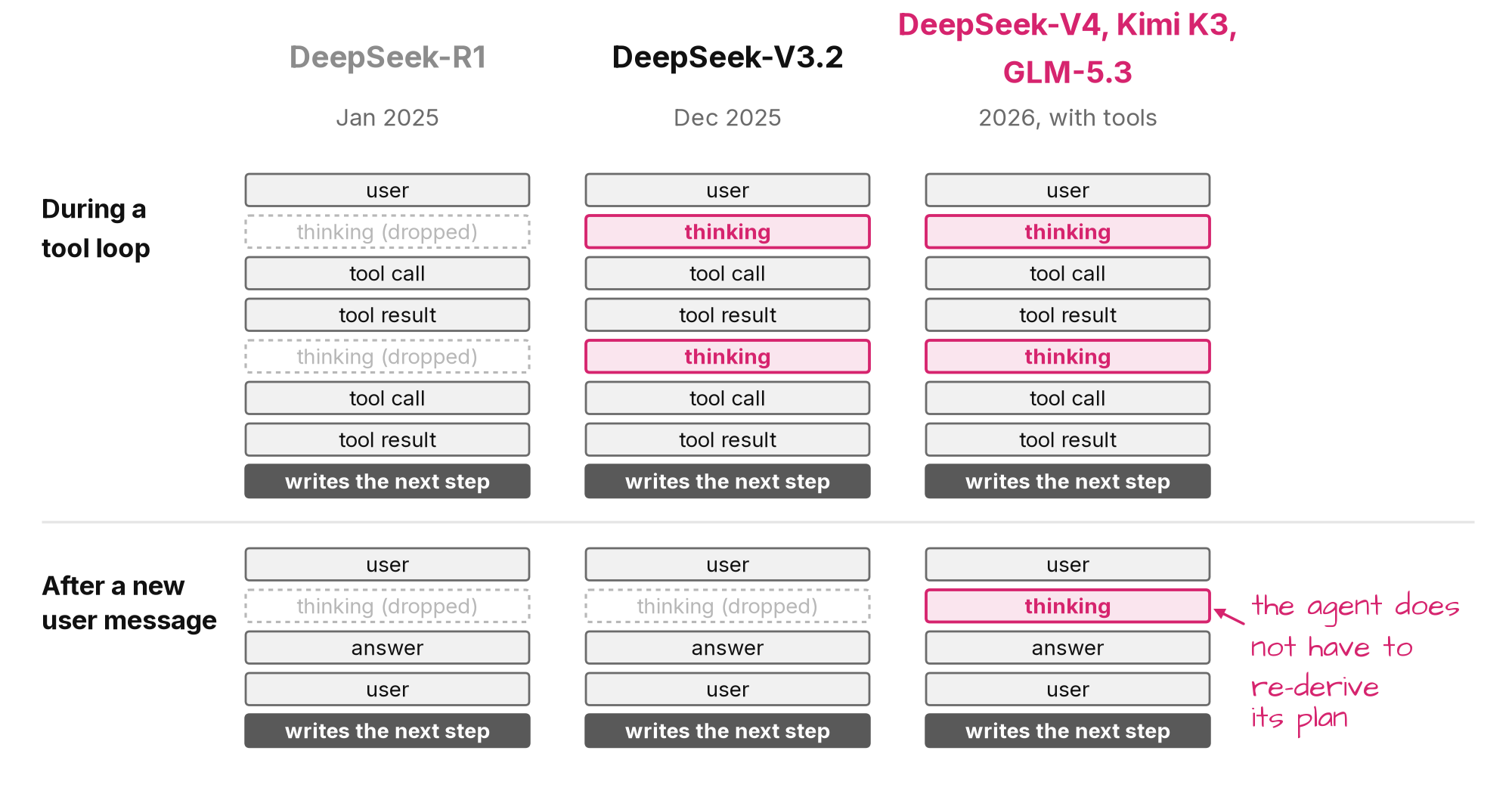
*Figure 2: Which earlier thinking sections are still in the model's input when it writes its next step, in the middle of a tool loop (top) and after a new user message (bottom). The R1 column applies R1's policy to tool calls, as described in the DeepSeek V3.2 report. DeepSeek V4 keeps the reasoning only when tools are involved and still removes it in plain chat.*
The DeepSeek V3.2 and V4 reports both explain why they made this change. When the old reasoning was removed, the model had to work through the whole problem again after every tool call or every user message, which wasted a lot of tokens in long agent sessions. Kimi K3 goes one step further: according to its model card, it was trained with the old reasoning kept in place, so applications have to send the complete previous messages, including the reasoning, back to the model.
To summarize this section, a reasoning model in 2026 writes a thinking section before every answer and every tool call, reads an effort level from its prompt, and keeps its earlier thinking when it works as an agent.
## 2. When should we use reasoning models?
Now that we know what a reasoning model is, let's look at when it is worth using one, before we get to how they are trained.
In early 2025, the usual advice looked roughly like this:
- Reasoning models are good at problems that need several steps, such as math competitions, logic puzzles and hard programming tasks.
- They are a poor fit when we need a fast and cheap answer, since every token of reasoning takes time and costs money.
- They are not needed for simple questions or for looking up facts, and they can even do worse there, for example by overthinking a simple question.
That advice assumed that we could choose between a reasoning model and a regular one. With flagship models that always reason, the question becomes how much reasoning to ask for, which is what the effort setting controls.
The [DeepSeek V4 report](https://arxiv.org/abs/2606.19348) has a useful table for this question, because it evaluates the same model, DeepSeek-V4-Pro, in three modes: Non-think (no reasoning), Think High and Think Max. Figure 3 shows six of its rows. Apex Shortlist and HMMT are math competition problems, HLE (Humanity's Last Exam) is a set of very hard expert-level questions, SimpleQA-Verified asks short factual questions, and SWE Verified and Terminal Bench 2.0 test the model as a coding agent that has to fix real bugs or finish tasks in a terminal.
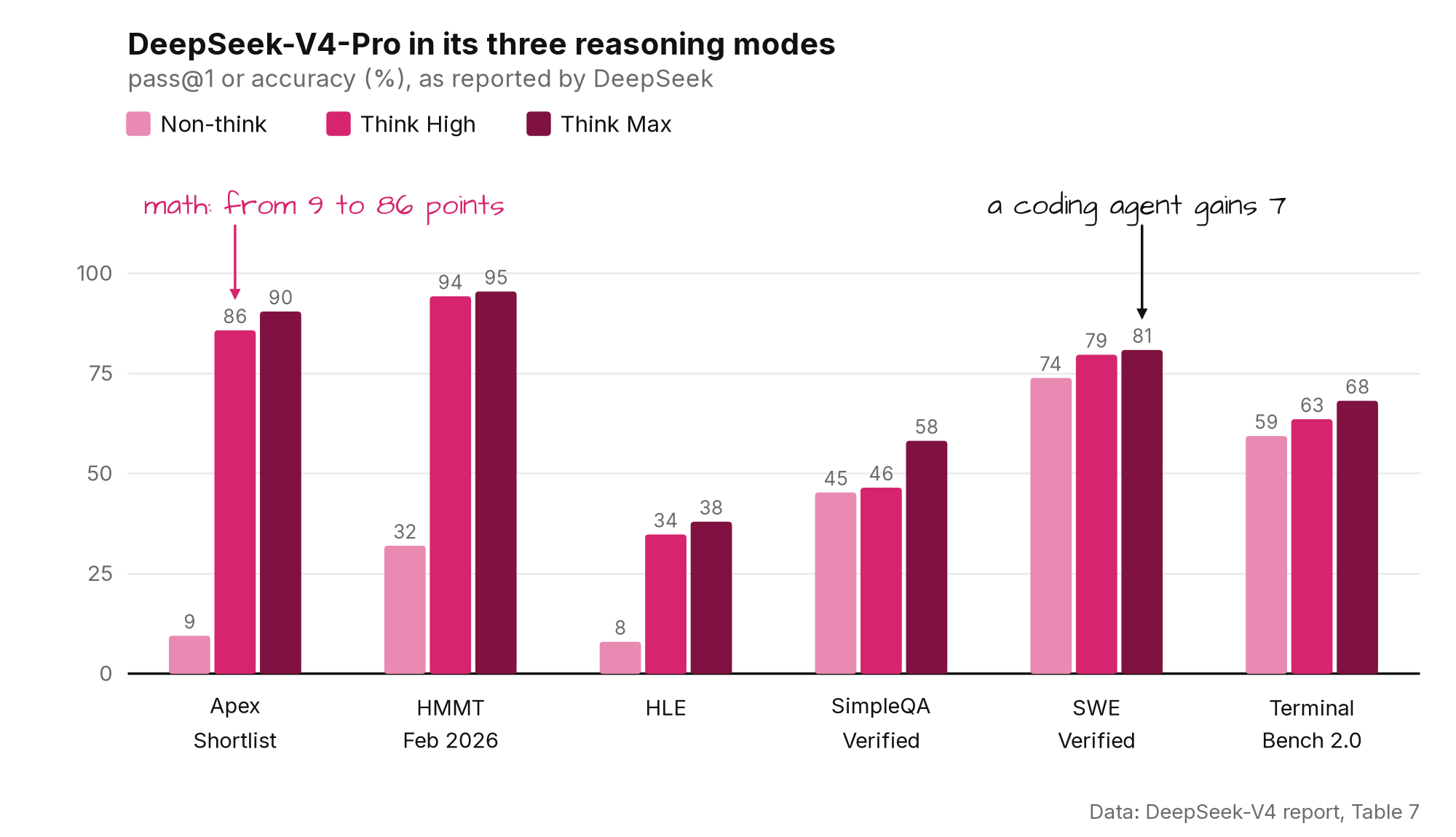
*Figure 3: DeepSeek-V4-Pro in its three reasoning modes, on six of the benchmarks in Table 7 of the DeepSeek V4 report.*
As shown in Figure 3, how much reasoning helps depends a lot on the task. On competition math, reasoning makes almost all the difference. On the Apex Shortlist, the score goes from 9.2% without reasoning to 85.5% with Think High. On the coding agent benchmarks, the gains are much smaller, for example from 73.6% to 80.6% on SWE Verified. My guess is that a coding agent already gets a lot of its "thinking" from the loop itself, since it runs the code, reads the error messages and tries again.
The SimpleQA-Verified row is interesting, because it goes against the old advice about factual questions. The score barely changes from Non-think (45.0%) to Think High (46.2%), but it jumps to 57.9% with Think Max, and DeepSeek notes that both V4 models do better on knowledge benchmarks with more reasoning. I would not read too much into one benchmark, but at least for this model, more reasoning did not make the factual answers worse.
What does the extra reasoning cost? The [DeepSeek V4.1 report](https://huggingface.co/deepseek-ai/DeepSeek-V4.1-Flash/blob/main/DeepSeek_V41_Tech_Report.pdf) tested its effort setting at values between 25 and 100. Going from the lowest to the highest of these settings raised the average score over eight reasoning benchmarks from 67.1% to 76.3%, and it made the responses about 2.5 times longer. On the hardest math set, MathArena Apex, the responses grew from about 29,000 to about 86,000 tokens on average.
DeepSeek's own recommendation is to use the middle of the range for most work. According to the report, efforts between 60 and 80 already reach most of the accuracy of the maximum setting with less than half of its tokens, while the last step to 100 makes agent sessions 1.6 to 1.8 times longer for small gains. (In DeepSeek's API, the setting `high` corresponds to 75.)
There is also evidence that the older reasoning models wrote more than they needed to. In the [Kimi K2.5 report](https://arxiv.org/abs/2602.02276), Moonshot describes a training method called Toggle (which I will explain in section 6.1). Applied to their earlier Kimi K2 Thinking model, it cut the length of the responses by 25 to 30% on average with almost no loss in accuracy, and the shorter reasoning contained far fewer repeated checks and mechanical calculations.
## 3. A short primer on post-training
Most of this article is about post-training, so let's briefly go over its two main techniques, supervised fine-tuning and reinforcement learning. If you already know both, you can skip ahead to section 4.
Supervised fine-tuning (SFT) is the simpler of the two. We collect example conversations, each with a prompt and a good response, and train the model to reproduce the responses token by token. This is the same next-token training as in pre-training, only on a much smaller and more carefully chosen dataset. For a reasoning model, the example responses include a thinking section, so the model learns to reason in that style.
Reinforcement learning (RL) works differently. Instead of showing the model good responses, we let the model write its own responses and give each of them a score. The model that is being trained is called the policy, the responses it writes during training are called rollouts, and the score is called the reward. Training then makes responses with a high reward more likely and responses with a low reward less likely.
Where does the reward come from? There are two main options:
- For many reasoning tasks, a program can check the answer. A math answer can be compared with the known solution, and a piece of code can be run against test cases. These are called verifiable rewards, and they are hard to game, since the checking program does not care how convincing a response sounds.
- For everything else, such as writing an email, no program can check the result. Here, the reward comes from a reward model, which is a separate model trained to predict which of two responses a person would prefer. This is the setup known as reinforcement learning from human feedback (RLHF), which was used to train instruction-following models such as [InstructGPT](https://arxiv.org/abs/2203.02155).
The RL algorithm that almost all models in this article use is GRPO (Group Relative Policy Optimization), which DeepSeek introduced in the [DeepSeekMath paper](https://arxiv.org/abs/2402.03300). The idea is simple. For each prompt, the model writes a group of several responses. Each response gets a reward, and then each reward is compared with the average reward of the group, as illustrated in Figure 4.
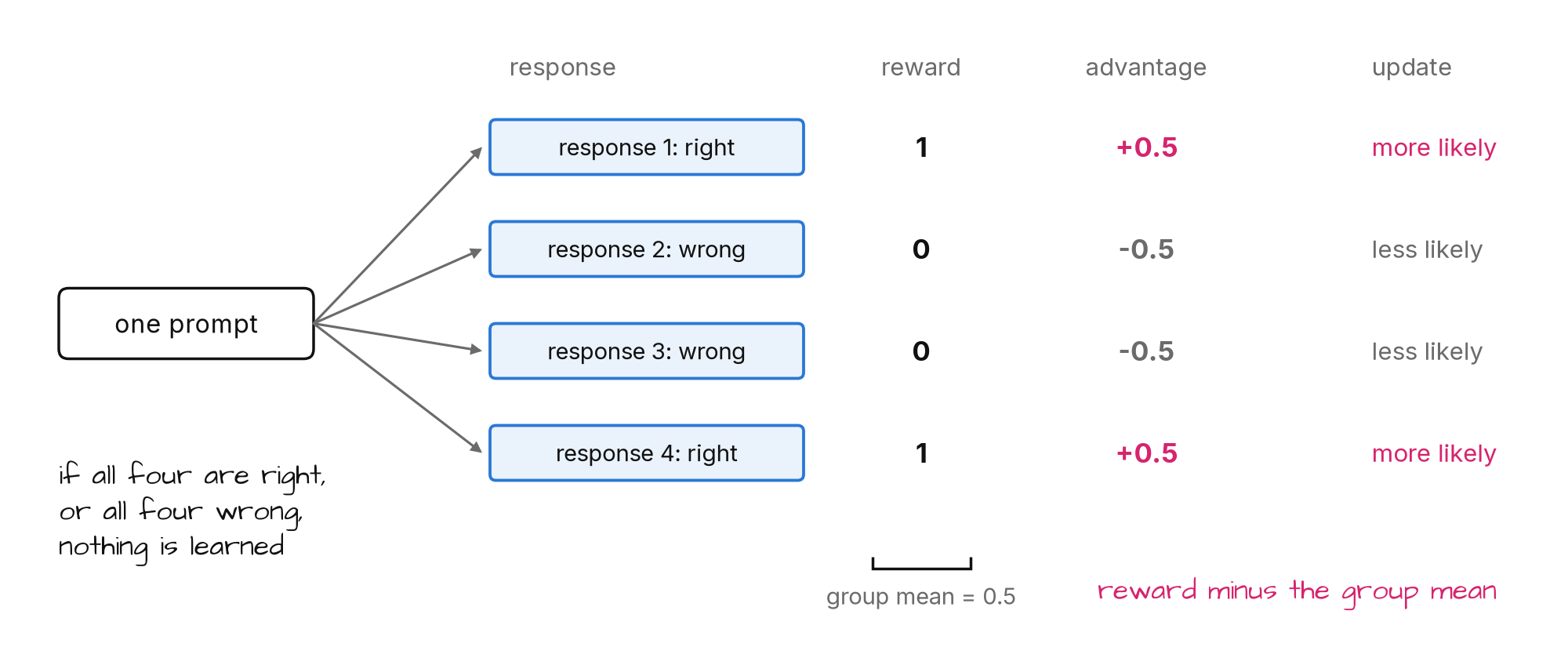
*Figure 4: One GRPO step for one prompt. Each response is scored, and its advantage is its reward minus the average reward of its group.*
In Figure 4, two of the four responses are right, so the average reward of the group is 0.5. The two right responses therefore get a score of +0.5, and the two wrong ones a score of −0.5. This relative score is called the advantage. The model is then updated so that the tokens of the responses with a positive advantage become more likely, and the tokens of the responses with a negative advantage become less likely. (Most versions of GRPO also divide the advantages by the spread of the rewards in the group and limit how far one update can change the model, but the comparison within the group is the main idea.)
Note that if all four responses are right, or all four are wrong, every advantage is zero, and the model learns nothing from that prompt. This is one reason why the labs put a lot of work into choosing training problems that are neither too easy nor too hard for the current model.
Compared with PPO, the older algorithm that was used for RLHF, GRPO does not need a second model to estimate how good a response is expected to be, because the group average takes over that role. This saves a lot of memory and computation.
## 4. A brief look at the DeepSeek-R1 training pipeline
With these terms in place, let's look at DeepSeek-R1. Its [technical report](https://arxiv.org/abs/2501.12948) (which DeepSeek revised in January 2026 with many more details) describes not one but three kinds of models: DeepSeek-R1-Zero, DeepSeek-R1, and a set of smaller DeepSeek-R1-Distill models. Figure 5 shows how the three were made.
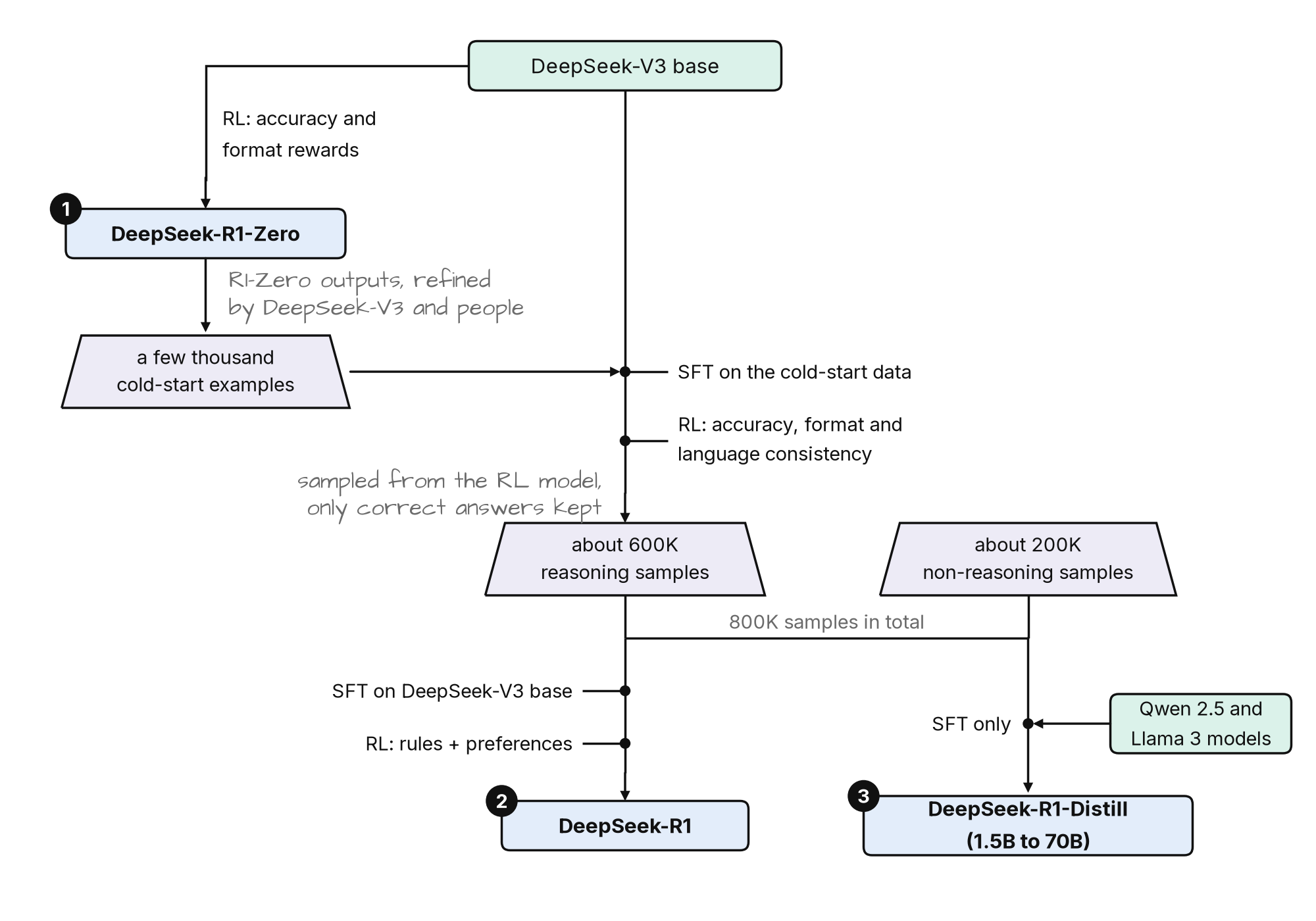
*Figure 5: How DeepSeek-R1-Zero (1), DeepSeek-R1 (2) and the DeepSeek-R1-Distill models (3) were trained, based on the DeepSeek-R1 report.*
Let's briefly go through the three models in Figure 5. I will come back to each of them in more detail in section 6.
1. DeepSeek-R1-Zero was trained with RL directly on the DeepSeek-V3 base model, which DeepSeek had released in December 2024, without any SFT stage first. Its rewards were two simple rules, one for a correct answer and one for putting the reasoning between the thinking markers.
2. DeepSeek-R1, the main model, starts from the same base model but adds SFT stages before and between its RL stages. This made its reasoning easier to read and made it much better at general tasks such as writing.
3. The DeepSeek-R1-Distill models are smaller open models from the Qwen 2.5 and Llama 3 families, with 1.5 to 70 billion parameters, that were fine-tuned on 800,000 examples from the R1 pipeline, using SFT only.
## 5. What a training pipeline looks like in 2026
The R1 recipe became a blueprint for many of the models that followed. Next, let's put it next to a pipeline from 2026: Kimi K3, which Moonshot AI released in July 2026, and whose [report](https://arxiv.org/abs/2607.24653) describes its post-training more clearly than any other report I read.
K3's post-training has three stages:
1. SFT, to give the model a good starting point. The SFT data was generated with earlier Kimi models and then checked in several verification steps and by human annotators.
2. RL, but not on a single model. Moonshot trains separate expert models for three areas (general tasks, general agent tasks and coding agents), and each of them at three effort levels (low, high and max), which makes nine experts.
3. Multi-teacher on-policy distillation (MOPD), which merges the nine experts back into the single K3 model. I will explain how this works in section 6.4.
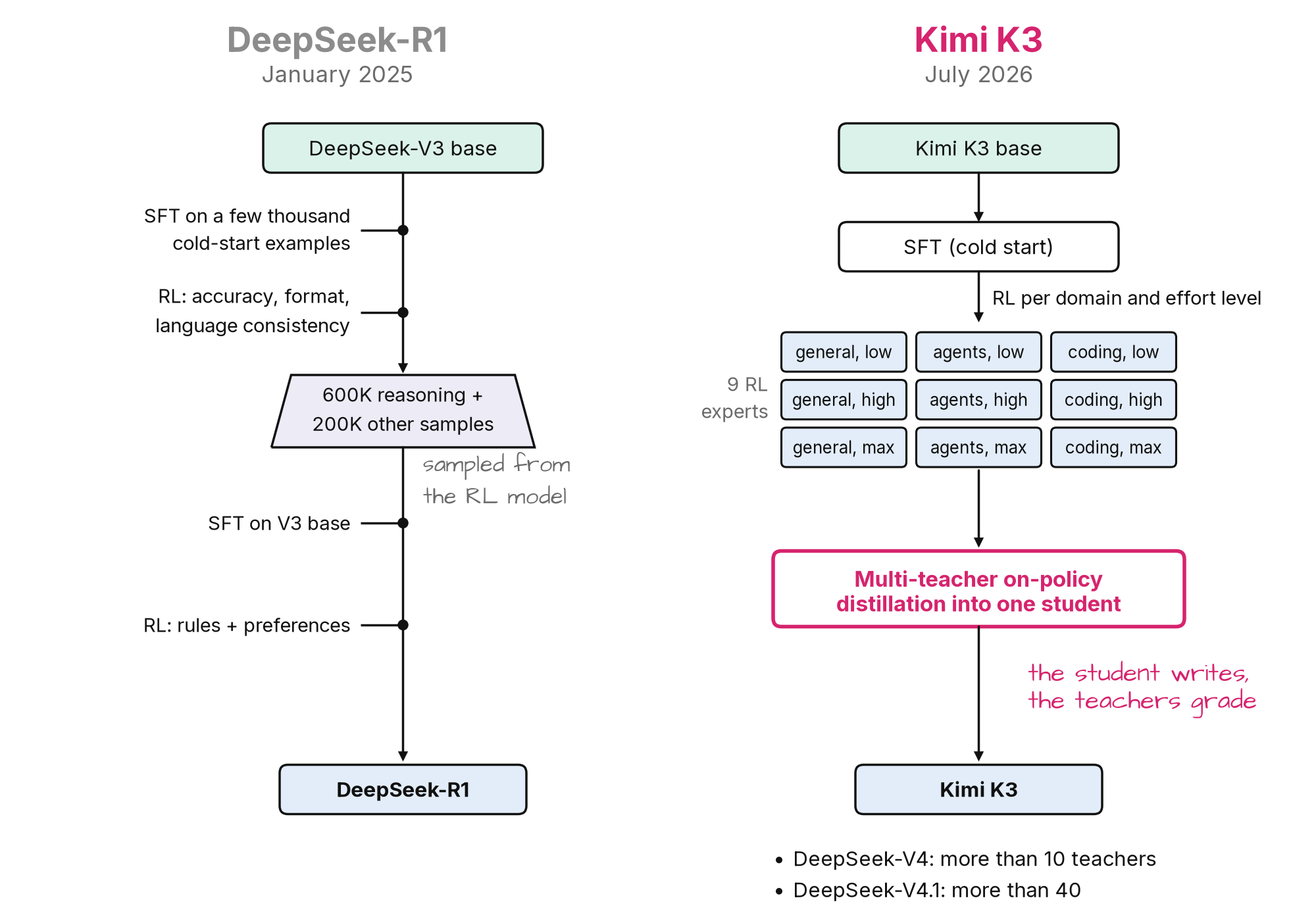
*Figure 6: The DeepSeek-R1 pipeline (left, simplified from Figure 5) and the Kimi K3 pipeline (right), based on the two technical reports.*
As shown in Figure 6, R1 is one line of models that alternates between SFT and RL. K3 first trains many specialists and then merges them into one model, and the merging step is a form of distillation rather than RL.
The other labs follow the same pattern with some variations:
- DeepSeek V4 (April 2026) trains a specialist for each domain with SFT and GRPO and then merges them with on-policy distillation from more than ten teachers. DeepSeek V4.1 (September 2026) uses more than 40 teachers.
- [GLM-5](https://arxiv.org/abs/2602.15763) (February 2026) runs its RL stages one after another, first for reasoning, then for agent tasks, then for general chat. At the end, it uses on-policy distillation with its own earlier checkpoints as teachers, so that the model does not forget what it learned in the earlier stages.
- Xiaomi's [MiMo-V2-Flash](https://arxiv.org/abs/2601.02780), whose report came out in January 2026, describes the same three stages and introduced the name MOPD.
## 6. The four main ways to build and improve reasoning models
So far, we have looked at what reasoning models are and how two complete pipelines are put together. Now let's look at the individual techniques. There are four main approaches to making an LLM better at reasoning:
1. Inference-time scaling, which spends more computation when the model is used, without training it further.
2. Pure RL, as in DeepSeek-R1-Zero.
3. SFT followed by RL, as in DeepSeek-R1.
4. Distillation, as in the DeepSeek-R1-Distill models.
In early 2025, these were four separate options. In each of the following subsections, I will first explain the approach as it worked around R1, and then look at what it became in the 2026 models.
### 6.1 Inference-time scaling
Inference-time scaling (also called test-time scaling) means improving answers by spending more computation at the time the model is used, rather than during training.
The simplest form is chain-of-thought (CoT) prompting. In the 2022 paper [Large Language Models are Zero-Shot Reasoners](https://arxiv.org/abs/2205.11916), Kojima and colleagues showed that just adding "Let's think step by step" to a prompt makes a model write out intermediate steps, which clearly improved its accuracy on math word problems. Since the model writes more tokens, this already counts as inference-time scaling.
A second form is to generate several answers and pick the best one. The simplest version is majority voting, also known as [self-consistency](https://arxiv.org/abs/2203.11171): we sample, say, 16 answers and return the answer that comes up most often. More elaborate versions use a process reward model, which is a separate model that scores each intermediate step, and search for the best sequence of steps, for example with beam search. (If you want to read more about these methods, the paper [Scaling LLM Test-Time Compute Optimally can be More Effective than Scaling Model Parameters](https://arxiv.org/abs/2408.03314) compares many of them.)
Interestingly, DeepSeek tried process reward models and Monte Carlo tree search (another search method) for R1 and listed both under "unsuccessful attempts" in its report. R1 does not search at all. Instead, it learned during RL to write longer reasoning for harder problems, which is a form of inference-time scaling that is built into the model.
This is the direction that the 2026 models took much further. The amount of reasoning is now a setting that the model is trained to follow. DeepSeek V4 has three modes, and according to the V4 report, each mode was trained with its own length penalty and its own maximum response length during RL. For the Think Max mode, DeepSeek also puts the following instruction at the start of the prompt, which I find worth quoting in full, since it shows quite directly what maximum effort means:
> Reasoning Effort: Absolute maximum with no shortcuts permitted. You MUST be very thorough in your thinking and comprehensively decompose the problem to resolve the root cause, rigorously stress-testing your logic against all potential paths, edge cases, and adversarial scenarios. Explicitly write out your entire deliberation process, documenting every intermediate step, considered alternative, and rejected hypothesis to ensure absolutely no assumption is left unchecked.
DeepSeek V4.1 replaced the three modes with a number from 1 to 100. The number is written into the system prompt, and the API settings `low`, `high` and `max` simply map to 50, 75 and 100. How do you train a model to follow such a number? DeepSeek's approach builds on the GRPO groups from section 3, as shown in Figure 7.
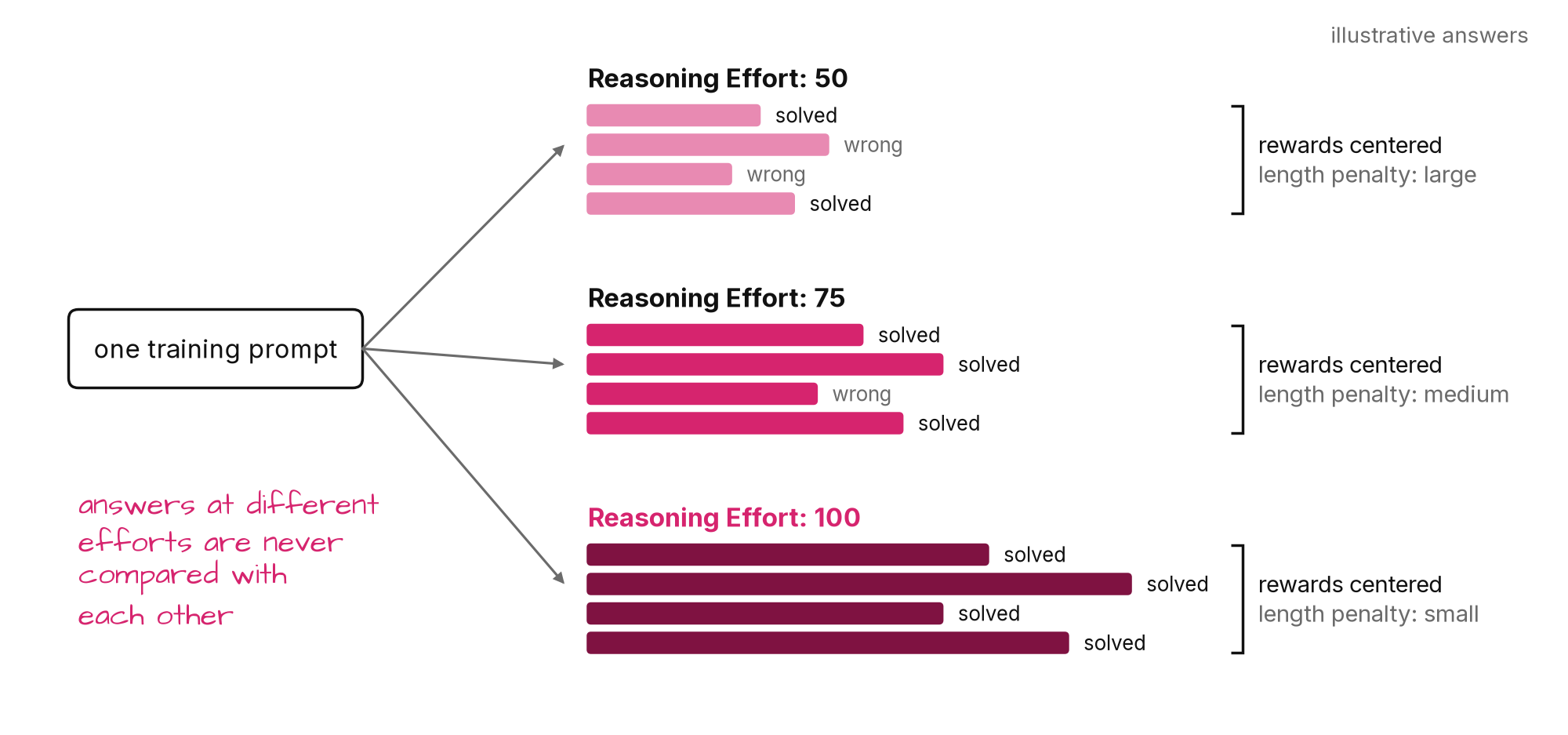
*Figure 7: How DeepSeek V4.1 trains its effort setting. The responses at each effort level form their own group with its own length penalty, and rewards are only compared within a group.*
For each training prompt, DeepSeek samples several responses at each of several effort levels, and the responses at the same effort level form their own group. Within a group, the rewards are compared exactly as in normal GRPO. In addition to the reward for a correct answer, every response gets a penalty that grows with its length, and the size of that penalty depends on the effort level. It is large at low effort and becomes much smaller at high effort, so a long response at effort 50 loses more reward than the same response at effort 100.
Why does each effort level get its own group? The report does not say, but I think the reason is that a long response at effort 100 would usually beat a short response at effort 50 if they were in the same group. The model would then learn to always reason as long as possible. With separate groups, the responses at each effort level only compete with each other.
Kimi K3 reaches a similar result with a token budget instead of a penalty. For each training problem, Moonshot estimates how many tokens it should take. Any response that uses more than a certain multiple of that budget gets a reward of −1, even if it is correct. Moonshot first trains the max-effort expert with a generous budget and then makes the budget tighter to train the high and low experts.
Budgets have a known downside, which Moonshot describes in the K2.5 report. A model that is trained with a strict budget can get used to short answers and keep giving them even when a problem needs more reasoning. Toggle, the method I mentioned in section 2, avoids this by switching back and forth between training phases with and without the budget. It also applies the budget only to problems that the model already solves reliably, so that the model never learns to give up on hard problems to save tokens.
Besides training the effort level into the model, the 2026 models also use extra computation outside a single response, in two ways:
- Checking their own work. DeepSeek's [DeepSeekMath-V2](https://arxiv.org/abs/2511.22570) trained a model to check mathematical proofs and used it as the reward for a proof-writing model. The V4 report uses the same idea for formal mathematics: it generates candidate proofs, keeps the ones that pass the model's own check, and gives them to an agent that writes a proof in Lean, a language in which a computer can verify proofs. With a lot of computation, this reached a perfect 120 out of 120 points on the 2025 Putnam competition.
- Splitting the work across several agents. Instead of one long chain of reasoning, the model divides a task into parts and runs several copies of itself in parallel. Kimi K2.5's Agent Swarm made broad search tasks up to 4.5 times faster this way. DeepSeek V4.1 trained a similar Agent Team mode with RL, and on the ProgramBench coding benchmark, it reached up to 30.04%, compared with 20.39% for a single agent.
Finally, since these models now write tens of thousands of tokens of reasoning, generating tokens quickly matters more than before, and most of the models come with a built-in way to speed it up. They include a small extra module that guesses several upcoming tokens at once, and the main model then checks all the guesses in one step, a technique called speculative decoding. You can see this module directly in the configuration files: the [`config.json` of GLM-5.3](https://huggingface.co/zai-org/GLM-5.3/blob/main/config.json) lists one such layer (`num_nextn_predict_layers: 1`), and the [one of DeepSeek V4.1-Flash](https://huggingface.co/deepseek-ai/DeepSeek-V4.1-Flash/blob/main/config.json) lists three, plus the settings of a separate draft module called DSpark. MiMo-V2-Flash reports up to 2.6 times faster generation with its three such layers.
### 6.2 Pure reinforcement learning
One of the most surprising results of the R1 report was that a model can learn to reason with RL alone. DeepSeek-R1-Zero was trained with GRPO directly on the DeepSeek-V3 base model, without any SFT, using two rule-based rewards:
- An accuracy reward. For math problems, the model had to put its final answer in a fixed format, so that a program could compare it with the correct answer. For programming problems, the code was run against test cases.
- A format reward for putting the reasoning between `` and ``.
DeepSeek deliberately did not use a reward model for these tasks, because the model being trained can learn to exploit a reward model's weaknesses over a long RL run, which is called reward hacking. For each training question, R1-Zero wrote 16 responses, which formed one GRPO group.
This simple setup worked remarkably well. Over about 10,000 training steps, R1-Zero's score on AIME 2024, a US high school math competition, went from 15.6% to 77.9%. Its responses also grew from a few hundred to several thousand tokens, without anyone asking for longer answers. The report even shows what DeepSeek called an "aha moment", in which the model stops in the middle of a solution, writes "Wait, wait. Wait. That's an aha moment I can flag here.", and starts to check its earlier steps again.
R1-Zero had two problems, though. Its reasoning was often hard to read, and it mixed languages, switching between English and Chinese within the same response. That is why DeepSeek added SFT stages for the main R1 model, as we will see in the next section.
What happened to pure RL by 2026? None of the flagship models in this article is trained with RL alone. Instead, RL became the stage that turns a fine-tuned model into a specialist, and that stage grew a lot. In the V3.2 report, DeepSeek wrote that its post-training already used more than 10% of the computation of its pre-training.
The RL algorithm itself changed surprisingly little. DeepSeek still uses GRPO, GLM-5 and MiMo use GRPO with small modifications, and Kimi uses its own variant, which also compares each response with the average of its group. Most of the new work went into three other areas: keeping the training data consistent, finding rewards for tasks that a program cannot check, and building environments for agents to practice in. Let's look at each of them.
The first area is a bit technical, but it turned out to matter a lot. During RL, the rollouts are generated by a fast inference engine (such as SGLang or vLLM), while the model updates are computed by a separate training framework. In theory, both run the same model and should give every token the same probability. In practice, they use different GPU code and sometimes different numerical precision, so their probabilities differ slightly. In a mixture-of-experts model, which sends each token to a few of its many expert sub-networks, a small difference can even send a token to a different expert. Figure 8 shows what such a mismatch looks like.
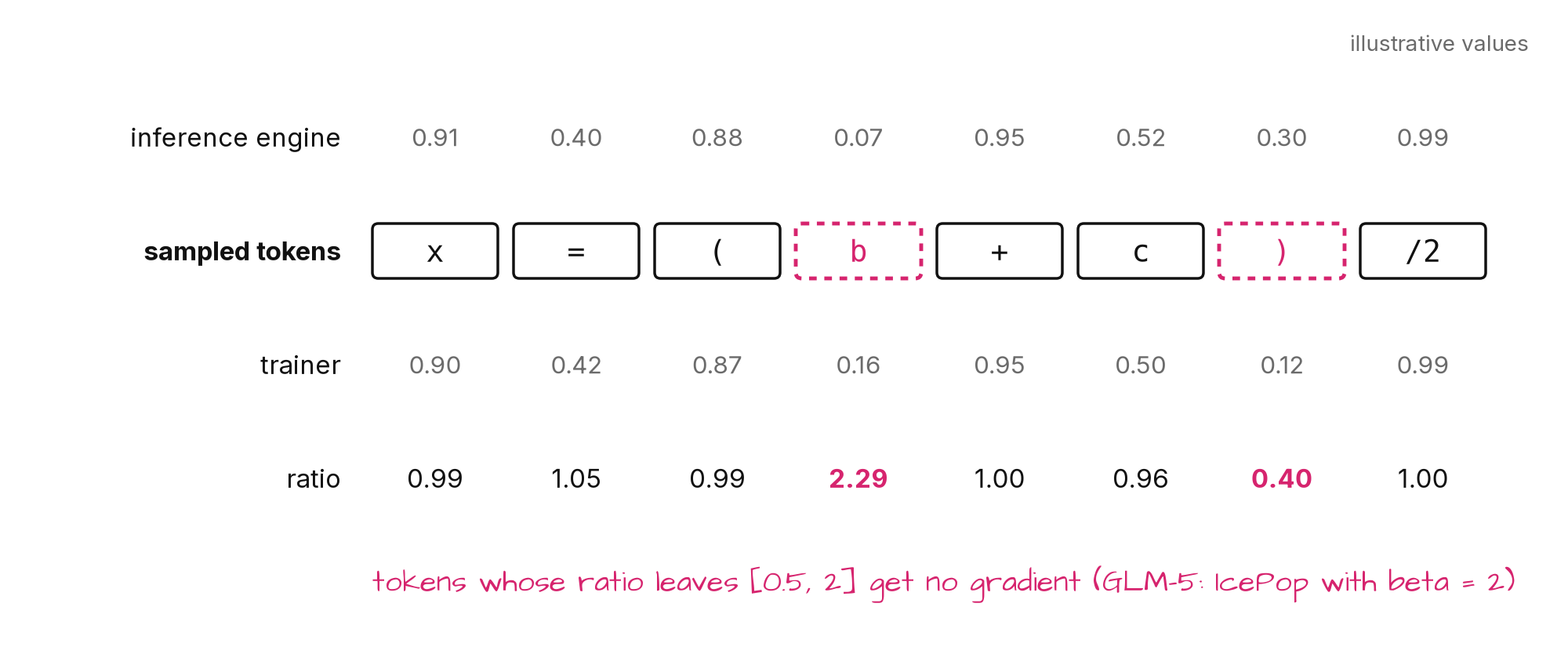
*Figure 8: The same sampled tokens, scored once by the inference engine and once by the trainer. The values are made up for illustration, since none of the reports lists per-token probabilities.*
These small differences add up, and several of the reports say that they can make RL training unstable. GLM-5's solution builds on a method called IcePop. For every token, it computes the ratio between the trainer's probability and the inference engine's probability, and if the ratio is above 2 or below 0.5, it leaves that token out of the update, as shown in Figure 8. Kimi uses a very similar rule.
DeepSeek's V3.2 report describes a few more fixes of this kind. The one it calls crucial for mixture-of-experts models is to record which experts the inference engine used for each token and to make the trainer use the same experts. GLM-5 also found that the part of its attention mechanism that picks which earlier tokens to look at needed a slower but deterministic implementation during RL, because the faster one degraded the model badly after only a few training steps.
The second area is the reward for tasks that a program cannot check. R1 used rule-based rewards for reasoning and a reward model for everything else. The 2026 models use generative reward models instead: an LLM reads the response, writes or follows a rubric (a list of criteria), and scores the response against it. DeepSeek V4 uses the model that is being trained as its own judge and trains its judging ability with RL as well. Kimi K3's judge has to follow a fixed procedure (read the output, write a rubric, score every candidate, record the scores), and to stop the model from winning by simply writing more, a response that is much longer than usual automatically loses. GLM-5 combines rule-based rewards, a classic reward model and a generative one.
The third area is the environments, meaning the tasks, tools and sandboxes that agents practice in during RL. DeepSeek V3.2 already built more than 1,800 environments with 85,000 prompts, and GLM-5 more than 10,000 software engineering environments. DeepSeek V4.1 goes further and uses agents to create, test and repair new training tasks, which then run in a sandbox system that can host millions of containers. The agents also find ways to cheat during training. The V4.1 report lists, among other things, agents that exploited a permission bug in the file system, read answers from package mirror servers, and deleted system files.
The DeepSeek V4.1 report states the lesson of this section quite directly: its post-training "introduces no algorithmic innovation", and almost all of its improvements come from more, more varied and better-verified training tasks and environments. GLM-5.3 is another example. It uses the same base model as GLM-5.2, and according to its model card, all of its improvements come from post-training.
### 6.3 Supervised fine-tuning plus reinforcement learning
DeepSeek-R1, the main model, was built to fix R1-Zero's problems with readability and mixed languages. Instead of starting RL from the base model, DeepSeek first fine-tuned the base model on a few thousand examples of clear, readable reasoning. The report calls this cold-start data. To make it, annotators rewrote some of R1-Zero's reasoning into a more natural, conversational style, an LLM then rewrote more examples in the same style, and people checked the results again. The whole pipeline then had four stages:
1. SFT on the cold-start data.
2. RL with the accuracy and format rewards from R1-Zero, plus a new reward for staying in one language.
3. A new round of SFT, starting again from the DeepSeek-V3 base model. This time, the data consisted of about 600,000 reasoning examples, which were sampled from the RL model of stage 2 (keeping only correct answers), and about 200,000 non-reasoning examples, such as writing tasks and factual questions.
4. A final round of RL with rule-based rewards for math and code and reward models for everything else.
The revised R1 report includes a table with the results after each of these stages, which shows nicely what each stage contributed. Figure 9 shows two of its rows: AIME 2024 for math, and AlpacaEval 2.0, which uses an LLM judge to estimate how often the model's answers to everyday requests would be preferred over those of a reference model. The checkpoints after the first three stages are called Dev1, Dev2 and Dev3, the final one is R1, and R1-Zero is included for comparison.
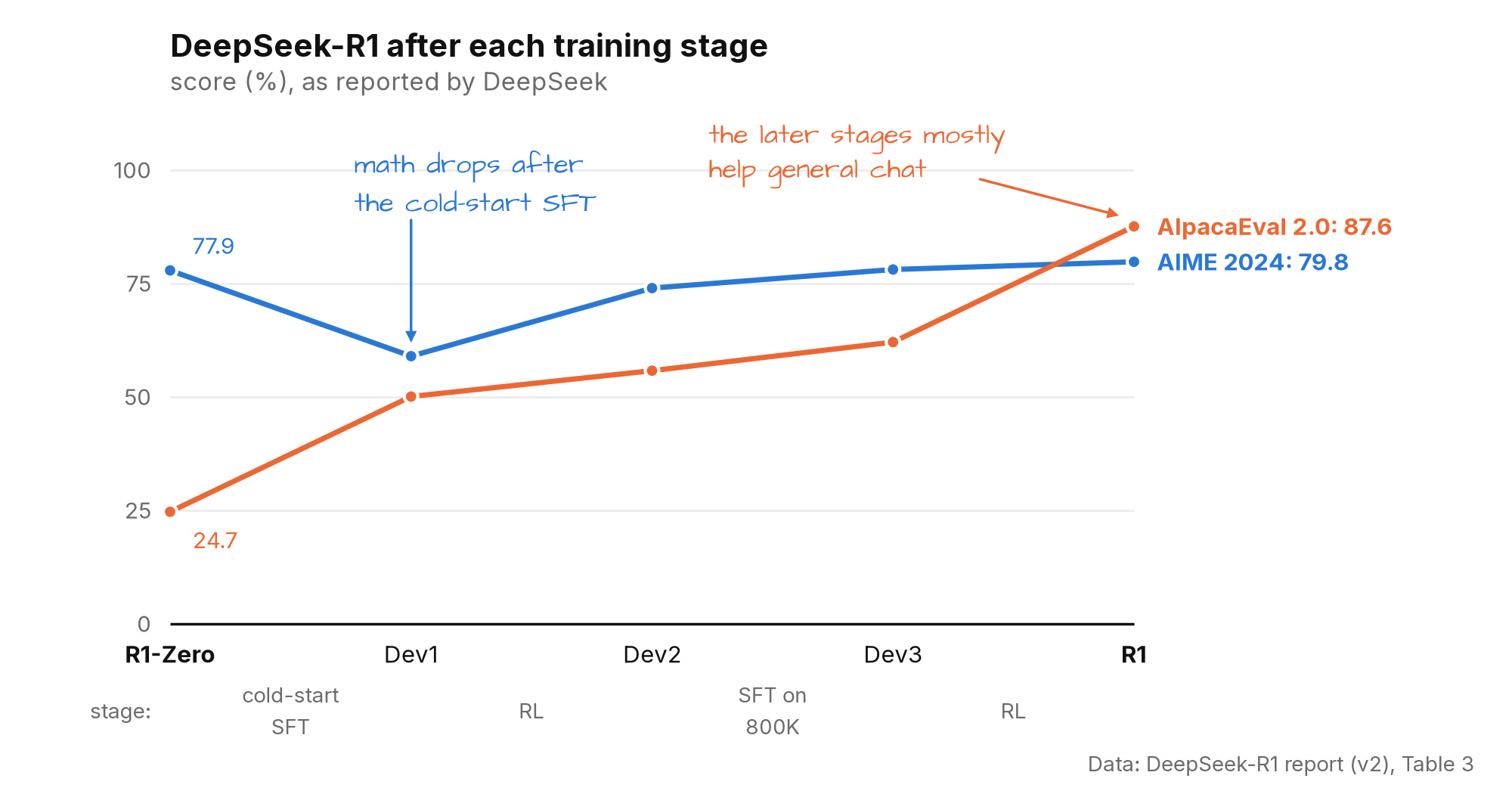
*Figure 9: AIME 2024 and AlpacaEval 2.0 scores after each stage of the DeepSeek-R1 pipeline, with DeepSeek-R1-Zero for comparison. The data comes from Table 3 of the revised DeepSeek-R1 report.*
As we can see in Figure 9, R1-Zero was already very good at math. The cold-start SFT stage (Dev1) actually lowered the AIME score from R1-Zero's 77.9% to 59.0%, and the following RL stage (Dev2) won most of it back. The large gains of the additional stages are on general conversations: the AlpacaEval score went from 24.7 for R1-Zero to 87.6 for R1. So the extra SFT and RL stages mainly turned a strong math model into a much better general assistant, while the final math score ended up only slightly above R1-Zero's.
In 2026, every pipeline starts with SFT in this way. The difference is mostly where the SFT data comes from. It is now largely generated by earlier models and then checked. Kimi K3's SFT data, for example, came from specialized models of earlier Kimi generations. DeepSeek V3.2 even created its first examples of reasoning combined with tool calls by simply asking the model, in the system prompt, to call tools in the middle of its reasoning.
One detail from GLM-5 is worth a closer look. A 2024 paper called [O1 Replication Journey](https://arxiv.org/abs/2410.18982) suggested an idea called journey learning: instead of training only on perfect solutions, the SFT data should also contain wrong attempts followed by their corrections, so that the model learns to notice and fix its own mistakes. GLM-5 uses a version of this for its agent training data. It keeps the wrong steps of an agent's trajectory in the training example but excludes them from the loss, so the model sees both the mistake and the correction, but is only trained to produce the correction.
### 6.4 Distillation, and multi-teacher on-policy distillation (MOPD)
In machine learning, distillation means training a smaller student model to imitate a larger teacher model. In the classic version, [introduced by Hinton and colleagues](https://arxiv.org/abs/1503.02531), the student learns to match the teacher's full output probabilities. For LLMs, the word is often used more loosely: the larger model generates responses, and the smaller model is fine-tuned on those responses with ordinary SFT.
This is how DeepSeek built the R1-Distill models. They took open models from the Qwen 2.5 and Llama 3 families, with 1.5 to 70 billion parameters, and fine-tuned them on the 800,000 examples from stage 3 of the R1 pipeline, without any RL. The results were surprisingly strong. The smallest model, R1-Distill-Qwen-1.5B, scored 28.9% on AIME 2024, compared with 9.3% for GPT-4o, and the 32B model reached 72.6%.
DeepSeek also tried the other route: they trained the same Qwen 2.5 32B base model with pure RL, the way R1-Zero was trained, for more than 10,000 steps. That model reached 47.0% on AIME 2024, far below the 72.6% of the distilled model. For smaller models, learning from a strong teacher worked much better than learning to reason through RL alone.
The obvious limitation of this kind of distillation is that it needs a stronger teacher, so it cannot produce a model that is better than the best model we already have. In early 2025, that made distillation the cheap option for small models, not something that the strongest models would use.
In 2026, distillation is the last stage of the strongest open models, but in a different form: it became on-policy. Let's look at what that means.
In SFT-style distillation, the student imitates responses that the teacher wrote. This means that during training, the student only ever sees situations that the teacher's responses lead to. When the student later makes a small mistake of its own, it ends up in a situation that never appeared in its training data. On-policy distillation reverses the roles: the student writes the response, and the teacher grades it, token by token, as shown in Figure 10.
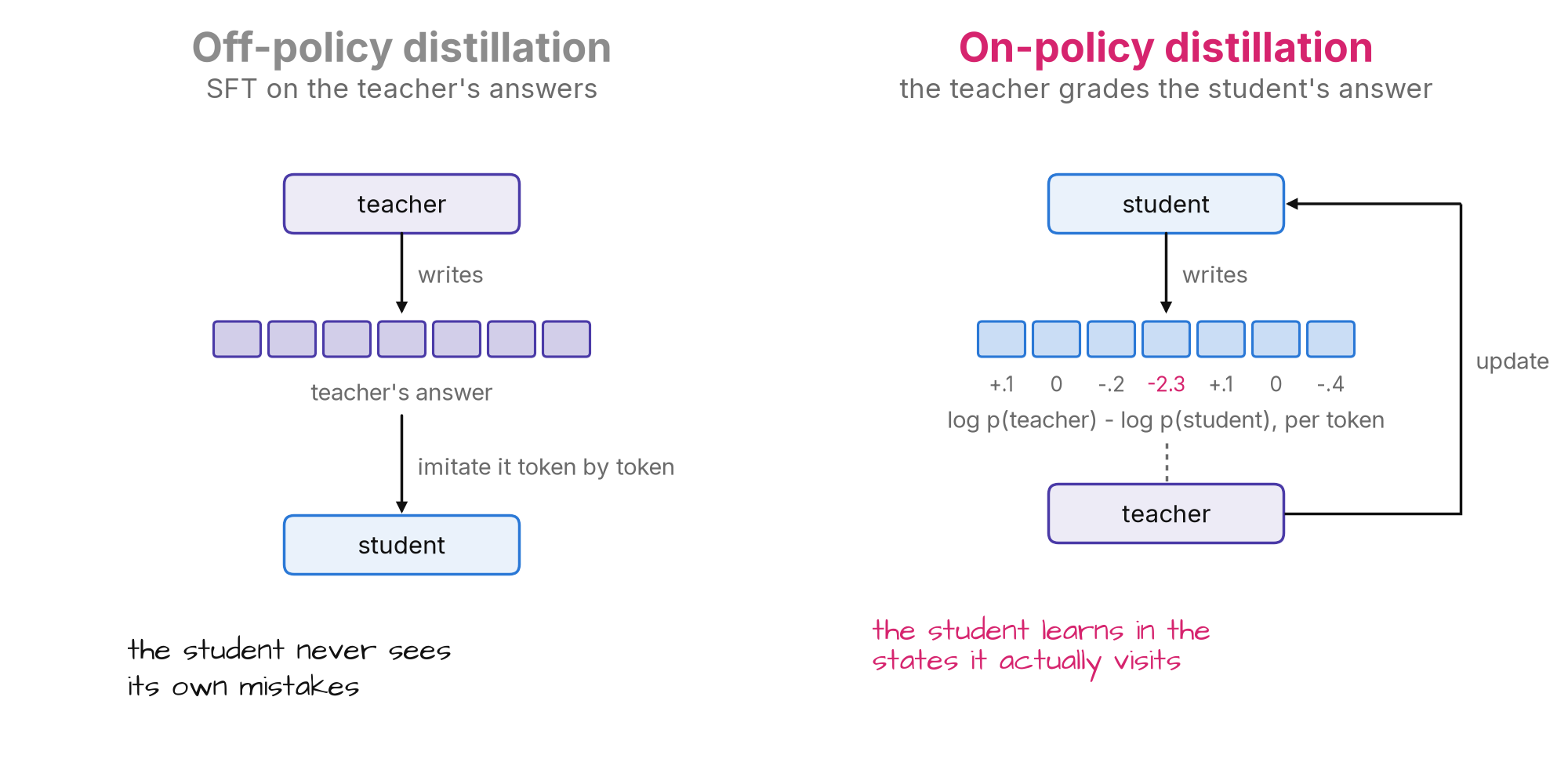
*Figure 10: Off-policy distillation (left) trains the student on the teacher's responses. On-policy distillation (right) trains the student on its own responses, with a grade for every token.*
How does the teacher grade a token? Recall that an LLM gives a probability to every possible next token. For each token that the student wrote, we can ask both models how likely they considered it. The grade is the difference between the logarithms of the two probabilities, the teacher's minus the student's. (The logarithm makes very small probabilities easier to work with.) If the teacher considers the token at least as likely as the student does, the grade is around zero or positive. If the teacher considers the token much less likely, for example because it starts a wrong approach, the grade is strongly negative.
These grades then take the place of the GRPO advantages from section 3, except that every token gets its own grade, while in GRPO all tokens of a response share one advantage. (In technical terms, training with these grades minimizes the reverse KL divergence between the student and the teacher, which is a measure of how much two probability distributions differ.)
The idea goes back to earlier papers such as [GKD](https://arxiv.org/abs/2306.13649) and MiniLLM, but the version that most 2026 reports cite is a [blog post by Thinking Machines](https://thinkingmachines.ai/blog/on-policy-distillation) from October 2025. In their experiments, a Qwen3-8B base model reached 60% on AIME 2024 after SFT, and 70% after about 150 steps of on-policy distillation. They also compared a longer on-policy distillation run, which reached 74.4% with 1,800 GPU hours, with the RL run described in the Qwen3 report, which reached 67.6% with 17,920 GPU hours.
Up to this point, there is one student and one teacher. The multi-teacher version, MOPD, was described most clearly in the MiMo-V2-Flash report. It addresses a problem that every lab with many specialists runs into. If we train one model on math, code, search and chat at the same time with RL, improving one skill often makes another one worse, which MiMo calls the see-saw effect. If we train the skills one after another, the model tends to forget the earlier ones. MOPD avoids both problems by training the specialists separately and merging them only at the end, with on-policy distillation, as illustrated in Figure 11.
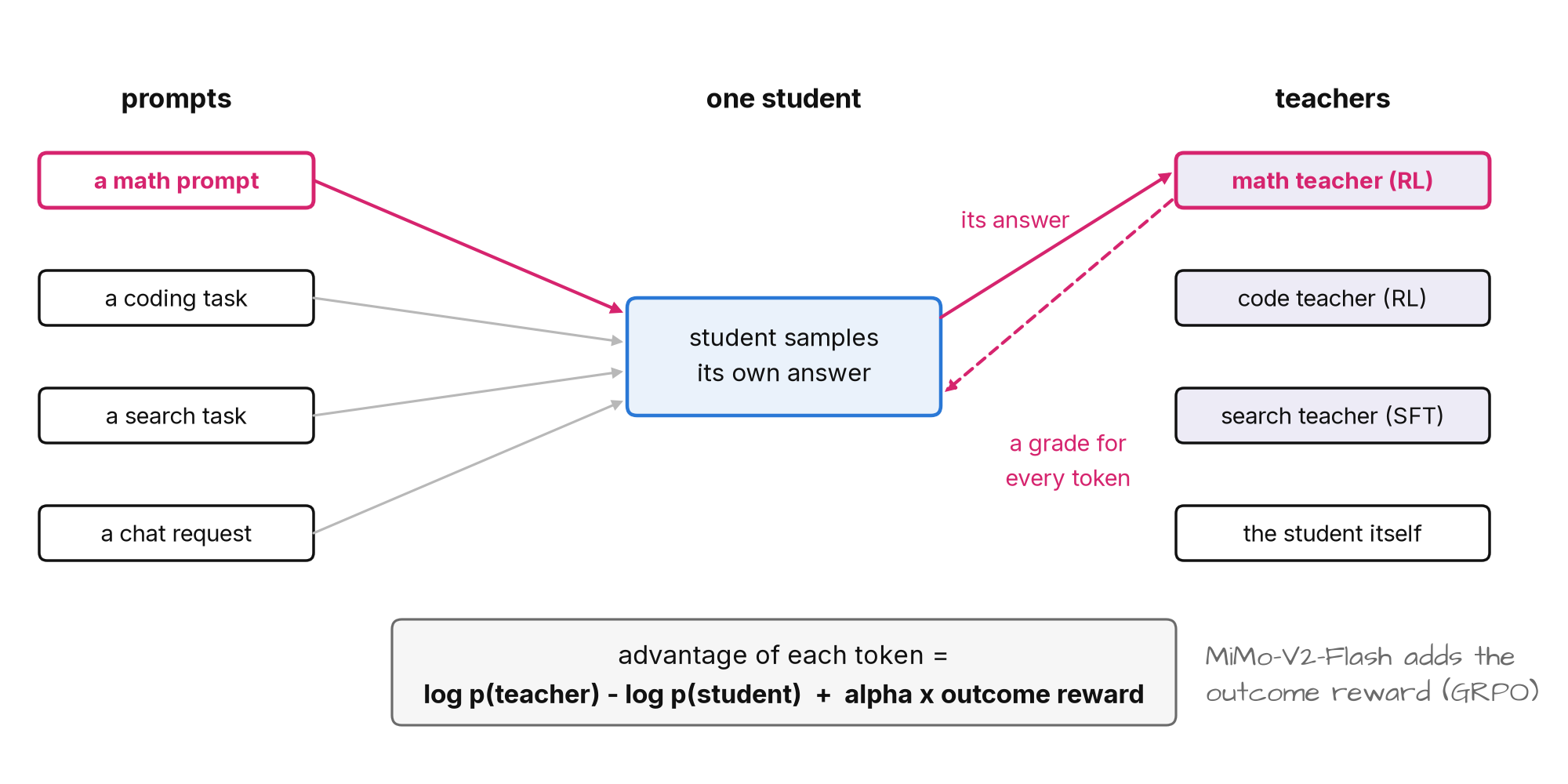
*Figure 11: Multi-teacher on-policy distillation as described in the MiMo-V2-Flash report. Each response is graded by the teacher for the domain of its prompt.*
The training loop is the same as in Figure 10, except that each prompt belongs to a domain, such as math or search, and the student's response is graded by the teacher for that domain. MiMo's teachers include RL-trained specialists for math, coding, search and tool use, but a teacher can also be an SFT model or even the student itself. For general benchmarks such as MMLU-Pro, MiMo's results table lists the student itself as the best teacher, which keeps those skills where they were. On top of the per-token grades, MiMo also adds the normal GRPO advantage from an outcome reward, so that the student also gets credit for actually solving the problem.
Does the merging actually keep what the teachers knew? MiMo's report has a table for this, and Figure 12 shows six of its rows.
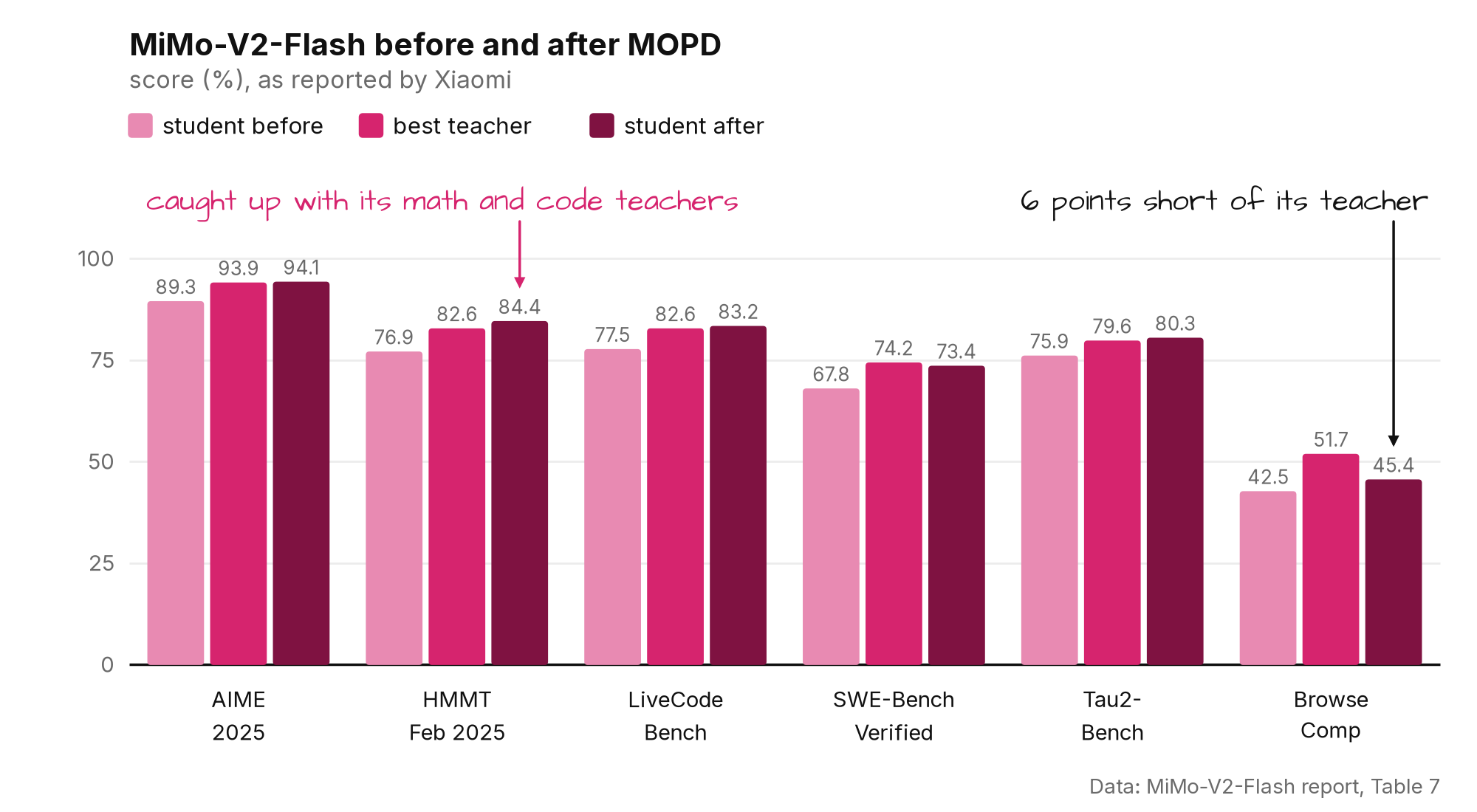
*Figure 12: MiMo-V2-Flash before MOPD, its best teacher for each benchmark, and after MOPD. The data comes from Table 7 of the MiMo-V2-Flash report.*
As we can see in Figure 12, the student caught up with its teachers on math and coding. On AIME 2025, it went from 89.3% to 94.1%, slightly above its teacher's 93.9%, and on HMMT, from 76.9% to 84.4%, above its teacher's 82.6%. The merging is not perfect, though. On BrowseComp, a benchmark for finding hard-to-find information on the web, the student ended up 6.3 points below its search teacher.
All the 2026 flagship models use some form of this, with different details:
- DeepSeek V4 merges more than ten teachers. Instead of comparing only the probabilities of the tokens the student wrote, it compares the full probability distributions over all possible tokens, because the report found the single-token version too noisy and unstable. DeepSeek V4.1 uses more than 40 teachers, which can even have different architectures.
- Kimi K3 uses the single-token version, with the grades limited to a fixed range. Moonshot reports that it also tried a richer variant and saw no clear advantage, so the two labs disagree a bit here.
- GLM-5 uses its own earlier RL checkpoints as teachers, to undo the forgetting between its RL stages. Since the grade for each token comes from the teacher, GLM-5 samples only one response per prompt instead of a whole group.
One more detail connects this back to section 2. Kimi K3's nine teachers include three effort levels for each domain, so the MOPD stage also merges the low, high and max behaviors into one student, which then picks its behavior based on the effort level in its prompt.
### 6.5 Summary of the four approaches
To summarize section 6, here is what became of the four approaches:
1. Inference-time scaling is now mostly trained into the model. During RL, the model learns how much to reason at each effort level, through length penalties or token budgets, and extra computation outside the model goes into self-checking and multiple agents rather than majority voting.
2. Pure RL is no longer used on its own for flagship models, but RL itself grew into a large part of post-training. Most of the recent work on it is about keeping the rollouts and the training consistent and about building rewards and environments.
3. SFT followed by RL is how every pipeline starts, and the SFT data now comes mostly from earlier models.
4. Distillation came back as the final stage of the strongest models, in its on-policy, multi-teacher form, where it merges the RL specialists into one model.
## 7. Thoughts on the state of open reasoning models
What strikes me most after reading these reports is how similar they have become. DeepSeek, Moonshot, Zhipu and Xiaomi all ended up with an SFT stage, RL specialists, and an on-policy distillation stage that merges them. Three of them also offer the same `low`, `high` and `max` effort levels to their users, and DeepSeek even writes that the V4.1 post-training contains no new algorithms.
If the recipe is shared, where do the differences between the models come from? According to the reports themselves, from the training data and the environments. I expect that this is also where most of the progress will come from over the next year, although that is my guess and not something the reports claim. It also means that the most important parts of these pipelines are the ones that are hardest to reproduce from a report.
How do the open models compare with the best closed models? The labs' own assessments are fairly modest. The Kimi K3 report says that K3 still trails Claude Fable 5 and GPT-5.6 Sol overall, and the DeepSeek V4.1 report says that a gap remains on the hardest tasks. Since the closed labs do not describe their post-training, it is hard to say whether that gap comes from the recipe, the scale of training, or the base models. The open labs do adopt some ideas from the closed models, though. The GLM-5 report, for example, points to Anthropic's Claude as the model that introduced interleaved thinking, the practice of reasoning before every tool call.
One last observation is about evaluation. The DeepSeek V4.1 report describes agents that tried to exploit the test infrastructure during evaluation, for example by decompiling core Ubuntu packages to find security holes in the CyberGym benchmark. As more and more benchmarks are agent tasks, I think this deserves as much attention as the scores themselves.
## 8. Reasoning models on a limited budget
Training a model like DeepSeek V4 or Kimi K3 takes the resources of a large lab. What can you do with a small budget?
In early 2025, two projects showed what was possible. [Sky-T1](https://novasky-ai.github.io/posts/sky-t1/), from the NovaSky team at UC Berkeley, fine-tuned the Qwen2.5-32B-Instruct model on 17,000 reasoning examples generated by another reasoning model, QwQ-32B-Preview, for less than $450. [TinyZero](https://github.com/Jiayi-Pan/TinyZero) reproduced the R1-Zero recipe on a 3B model for simple arithmetic puzzles, for less than $30, and the model learned to check its own answers through RL alone. The first is distillation on a budget, and the second is pure RL on a budget.
In 2026, I think the most promising option for a small budget is on-policy distillation from an open teacher. The Thinking Machines numbers above are a good example: the distillation run reached a better AIME score than the RL run with about a tenth of the GPU hours. The catch is that on-policy distillation needs the teacher's probability for every token that the student writes, so you need to be able to run the teacher yourself (or use an API that returns these probabilities for any text). This is where open weights matter. DeepSeek V4.1 and GLM-5.2 are released under the MIT license, and Kimi K3 and GLM-5.3 under their own licenses, so strong teachers are available to anyone with enough GPUs to run them, within the terms of those licenses. As far as I can tell, the simple per-token grade also assumes that the student and the teacher use the same tokenizer, which in practice usually means distilling into a smaller model from the same family.
The second lesson that carries over to small budgets is about the length of the reasoning. A model that is trained to answer briefly at a low effort level, as with Kimi's budgets or Toggle, can save a lot of inference cost on the many questions that don't need long reasoning.
Almost two years after R1, most of the work described in these reports goes into the environments that the models practice in, the rewards for tasks that a program cannot check, and the distillation stage that merges the specialists into one model, while the RL algorithm itself has barely changed. I am curious whether the next round of reports will describe the same pipeline, or whether the multi-agent training in DeepSeek V4.1 is the beginning of the next change.
## Sources
- [Understanding Reasoning LLMs](https://magazine.sebastianraschka.com/p/understanding-reasoning-llms), the 2025 article by Sebastian Raschka that this one follows
- [DeepSeek-R1 report](https://arxiv.org/abs/2501.12948)
- [DeepSeekMath report](https://arxiv.org/abs/2402.03300), which introduced GRPO
- [DeepSeek V3.2 report](https://arxiv.org/abs/2512.02556)
- [DeepSeek V4 report](https://arxiv.org/abs/2606.19348)
- [DeepSeek V4.1 report](https://huggingface.co/deepseek-ai/DeepSeek-V4.1-Flash/blob/main/DeepSeek_V41_Tech_Report.pdf)
- [Kimi K2.5 report](https://arxiv.org/abs/2602.02276)
- [Kimi K3 report](https://arxiv.org/abs/2607.24653)
- [GLM-5 report](https://arxiv.org/abs/2602.15763)
- [MiMo-V2-Flash report](https://arxiv.org/abs/2601.02780)
- [On-policy distillation](https://thinkingmachines.ai/blog/on-policy-distillation), Thinking Machines
- [GLM-5.3 model card](https://huggingface.co/zai-org/GLM-5.3) and [chat template](https://huggingface.co/zai-org/GLM-5.3/blob/main/chat_template.jinja)
- [Kimi K3 model card](https://huggingface.co/moonshotai/Kimi-K3)